

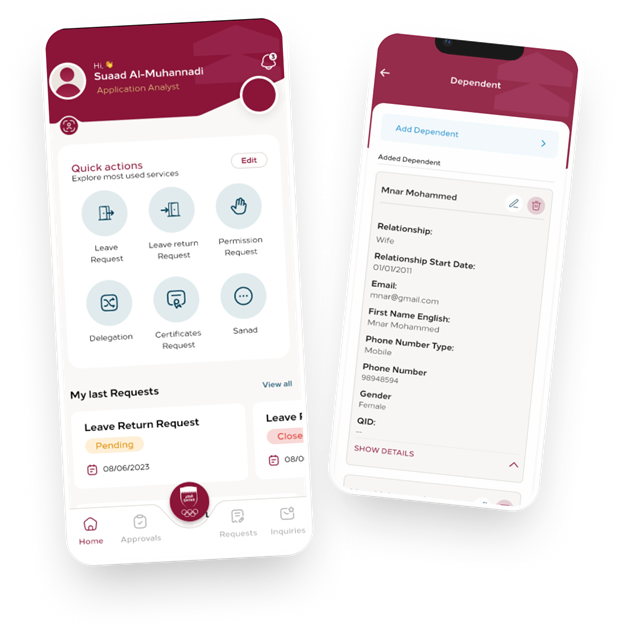
Applab partnered with the Qatar Olympic Committee (QOC) to develop Khadoom, a unified digital platform designed to simplify service management and improve operational efficiency across departments. Before Khadoom, users had to navigate multiple separate portals to submit requests, track approvals, manage inquiries, and access profile information. This fragmented setup created delays, data inconsistencies, and an inefficient user experience. To address this, Applab built a cloud-based, AI-enabled platform that consolidates multiple source systems into a single intelligent application. Built on Microsoft Azure, Khadoom provides a scalable, secure, and user-friendly environment that streamlines internal processes and supports future growth.
QOC relied on three separate source systems, each hosted on different portals and used for managing service requests, approvals, inquiries, and profile data. This fragmented environment led to several operational challenges: Employees had to switch between multiple portals to complete tasks Service requests and approvals were delayed Data inconsistencies appeared across systems Users lacked a centralized and efficient way to manage their work Although an earlier version of the Khadoom application had been introduced, it was limited in scope. It supported only one system and a smaller number of forms, which meant it could not fully solve the client’s broader operational challenges. QOC needed a solution that could unify all systems into one platform while delivering a seamless and efficient user experience.
Applab designed and developed Khadoom as an AI-enabled, cloud-based platform that brings multiple systems together into one centralized application. The solution combines Microsoft Azure cloud infrastructure with intelligent features to improve usability, scalability, and operational performance.
The project was delivered through a structured implementation approach:
The Khadoom platform delivered measurable improvements in both operational efficiency and user experience.
Key outcomes
40% faster task completion Consolidating multiple systems into one platform significantly reduced the time needed to complete requests and workflows.
25% reduction in operational costs Centralizing systems reduced maintenance complexity and administrative overhead.
10% improvement in revenue-related workflows Faster service processing helped accelerate workflows linked to revenue-generating activities.
35% increase in user engagement The intuitive interface and unified functionality supported rapid adoption across teams.
Khadoom transformed QOC’s internal operations by replacing fragmented workflows with one centralized digital environment.
The platform enabled:
Centralized access to services and forms Faster approvals and service processing
Improved data accuracy and consistency
A better user experience across departments
Scalable infrastructure ready for future expansion
Technology Stack
Microsoft Azure
Cloud infrastructure and system integration
OpenAI GPT-4o
AI-powered capabilities and intelligent features
Cloud-based architecture
Scalability, security, and reliability
System integration frameworks
Connecting multiple source systems into one unified platform Future Scalability
Khadoom was built with future growth in mind. Its modular, cloud-based architecture allows the platform to evolve as organizational needs expand. Planned future enhancements include: Expanding services and forms across more departments Introducing advanced AI capabilities such as predictive analytics Implementing intelligent automation for internal workflows Because of its flexible architecture, the solution can also serve as a model for other organizations facing similar challenges with fragmented systems and disconnected workflows.